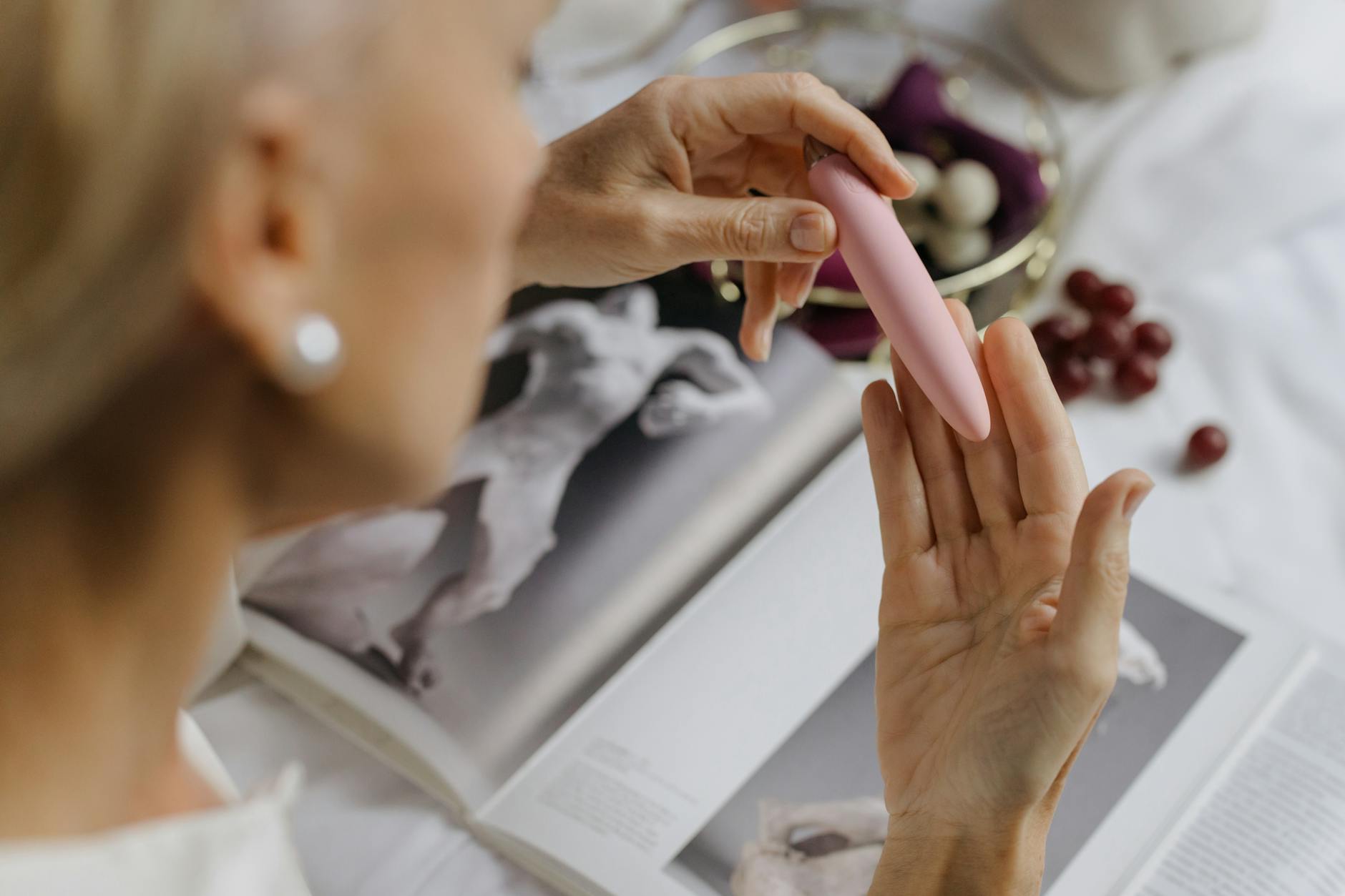
Let's talk about what actually happens after forty when you're suddenly exploring solo
You spent two decades (or three, or four) learning someone else's rhythm. Their preferences. The exact pressure they liked. When you're newly single and over forty, you're not starting from scratch. You're starting from muscle memory that belongs to someone else entirely. That's a different problem than being young and curious. That's having to unlearn.
Here's the thing that surprises most people: your body didn't forget how to feel pleasure. What changed is the context. The brain's response to touch, the nervous system's baseline, the freedom to explore without performance anxiety or someone's schedule dictating the timeline. All different now.
Why sensation feels different when you're going solo after years with a partner
There's a neurological piece and a psychological piece, and they're tangled together in ways worth untangling.
Neurologically, your clitoris has about 8,000 nerve endings. Those don't vanish when a relationship ends. But arousal itself requires blood flow, dopamine, and something neuroscientists call "cognitive engagement." When you've been trained for years to prioritize someone else's pleasure, your own arousal can feel distant. It's not because your body broke. It's because your brain was literally wired into a different circuit.
Psychologically, there's grief happening even if you wanted the relationship to end. There's also, frankly, reclaiming territory. Solo pleasure after decades of partnered sex isn't the same as exploring your body at twenty-five. It's an act of self-determination that sometimes feels transgressive just because it is. You're taking back the right to know what you want without filtering it through someone else's responses.
This is where lemon vibrators and other clitoral vibrators become genuinely useful tools. They're not a workaround. They're a way to rebuild sensitivity and confidence on your own timeline.
How suction-based stimulation rewires sensation faster than you'd expect
I'm going to get specific here because the mechanics matter. Suction vibrators like the Lem work differently than traditional vibration. Instead of oscillating side to side, they create a gentle vacuum around the clitoris. This stimulates the thousands of nerve endings without the direct friction that can feel overwhelming when you're relearning your body.
Why does that matter when you're over forty and newly single? Three reasons.
First, suction mimics the kind of stimulation that typically builds arousal more gradually. That slowness is useful when you're trying to rebuild confidence in your own body. You're not jumping straight to intensity. You're building it.
Second, the suction pattern is consistent. If you've been used to a partner's touch, which is always slightly varied and contextual, exploring with a lemon clitoral vibrator gives you something you can predict and reproduce. That predictability lets your nervous system relax into sensation instead of monitoring it.
Third, suction-based stimulation tends to feel novel to people who've spent years with hands or traditional vibration. That novelty itself can jumpstart sensitivity that's been dampened by routine or stress.
The mental side: permission and presence
Let me be direct about this. Women over forty who are newly single often carry a specific guilt about pleasure. You don't have to answer to anyone. You're allowed to be selfish with your time and your body. And yet. Decades of training runs deep.
Using a tool like a lemon sexual toy can actually bypass some of that guilt. It's not cheating on anyone. It's not taking time from a partner's needs. It's solitary and intentional and entirely yours. Something about introducing a physical object shifts the mental frame from "Is this selfish?" to "This is self-care." I've watched this happen in my practice hundreds of times. The introduction of a device often gives people permission they were already entitled to.
The other mental piece is presence. When you're relearning your body solo, you need to be fully there. Lemon vibrators and similar lemon clitoral vibrators work best when you're not distracted. That requirement to be present often feeds back into better sensation. You're not monitoring how you look or whether you're performing correctly. You're just feeling.
Building a foundation: what to expect in the first month
Most people report one of two patterns in the first few weeks of solo exploration with a vibrator. Either sensation builds gradually and you find intensity you didn't know was available, or nothing much happens and you feel frustrated. Both are normal.
If sensation is building, keep going. You're rewiring your nervous system's expectations. This can take weeks. The clitoris has memory, and if it spent years responding to a partner's touch, it takes time to respond differently.
If nothing much is happening, you're likely in your head. Presence is the real tool here. A lemon vibrator can't fix anxiety or distraction. It can only create the conditions where those things might ease. Try using it at a time when you're genuinely alone, when you're not thinking about what's next, when you have at least twenty minutes.
Temperature matters too. Arousal requires blood flow, and blood flow responds to comfort. A warm room, clean sheets, maybe a moment of just breathing before you start. These aren't luxuries. They're part of the tool.
Why lemon vibrators work especially well for midlife exploration
There's research on this, though the research on sexual pleasure is surprisingly limited. What we know from therapy and from talking with hundreds of clients is that people rediscovering pleasure after forty tend to respond well to devices that require intention rather than just switching them on.
The Lem and similar lemon clitoral vibrators have a learning curve. They're not complicated, but there's a rhythm to them. Finding the right pattern, the right intensity, the right positioning. That learning curve is actually the feature. It keeps you engaged. It prevents autopilot. And it gives you a sense of agency and skill that transfers to everything else.
Also, frankly, the design matters. A lemon sexual toy that looks interesting or beautiful, that feels good in your hand, that doesn't look like a medical device. Those details shift how you feel about using it. You're not treating yourself. You're not healing yourself. You're exploring yourself because you're curious.
When to bring a partner back into the picture
You don't have to. Plenty of people discover that solo pleasure is exactly what they needed, and they're content to keep it that way. But if you do want to eventually partner again, having done this solo work first is genuinely valuable.
You know what you like now. You know what intensity works. You've had the experience of orgasms that came entirely from your own effort and intention. That confidence transfers. When you do eventually have a partner, you're not trying to rediscover pleasure with them while also managing their ego or timeline. You're inviting them into something you already know.
Sharing a lemon vibrator with a partner, if that becomes relevant, is also straightforward. You know how it works. You know what feels good. You can guide them. Or you can just use it while they watch. The point is you're not starting from zero. You're not in that vulnerable place of not knowing what you want.
Rebuilding pleasure after forty isn't about becoming someone else
It's about becoming more fully yourself. A lemon clitoral vibrator is just a tool for that. The real work is the permission, the presence, and the willingness to take time to learn something about your own body that you may not have known before. That's available to you regardless of what's happened in your past. Your sensitivity isn't gone. Your capacity for pleasure isn't diminished. You're just building a relationship with them that's entirely your own now.
FAQ: Common questions about solo exploration and lemon vibrators over forty
Will using a lemon vibrator make partnered sex feel less satisfying if I date again?
No. The opposite, actually. Knowing your own body, knowing what pleasure feels like for you, having baseline confidence about sensation. All of that makes partnered sex better. You're not starting from zero with a new partner. You're starting with self-knowledge.
How long before I feel "normal" sensation again after years of the same kind of touch?
It varies. Some people notice shifts in a few weeks. Others take a few months. Sensitivity isn't a fixed thing. It responds to attention, novelty, presence, and sometimes just permission. If you're using a tool like a lemon sexual toy consistently, you're usually seeing movement within a month. But consistency matters more than speed.
Is it weird to prefer a vibrator to partnered sex even after I've rebuilt sensation?
Not even a little. Solo pleasure and partnered pleasure aren't in competition. They're different experiences that activate different parts of you. Some people find that solo pleasure with a lemon clitoral vibrator feels more reliably satisfying than partnered sex, and that's completely valid. You don't have to choose.
What if nothing happens the first time I use a lemon vibrator?
That's honestly fine. You've introduced something new and different to your body. That's information. Try it again when you're more relaxed, more present, when you have genuine time. The first experience doesn't determine every future experience. Sometimes it takes a few tries for your nervous system to recognize what's happening as good.
Can I use a lemon vibrator if I have numbness or reduced sensation?
Yes, and that's actually a common reason people reach for them. If sensation has been dampened by hormones, medication, stress, or just years of routine, suction-based stimulation often reaches nerves that traditional touch misses. It's worth trying if that's your situation.
How do I know if I'm using it right?
You'll feel something different than you expect. That might be pleasure, or it might just be novelty and sensation. Both are fine. From there, you experiment. Different patterns, different intensities, different positioning. There's no right way. There's just what feels good to you, which is the only metric that matters.